
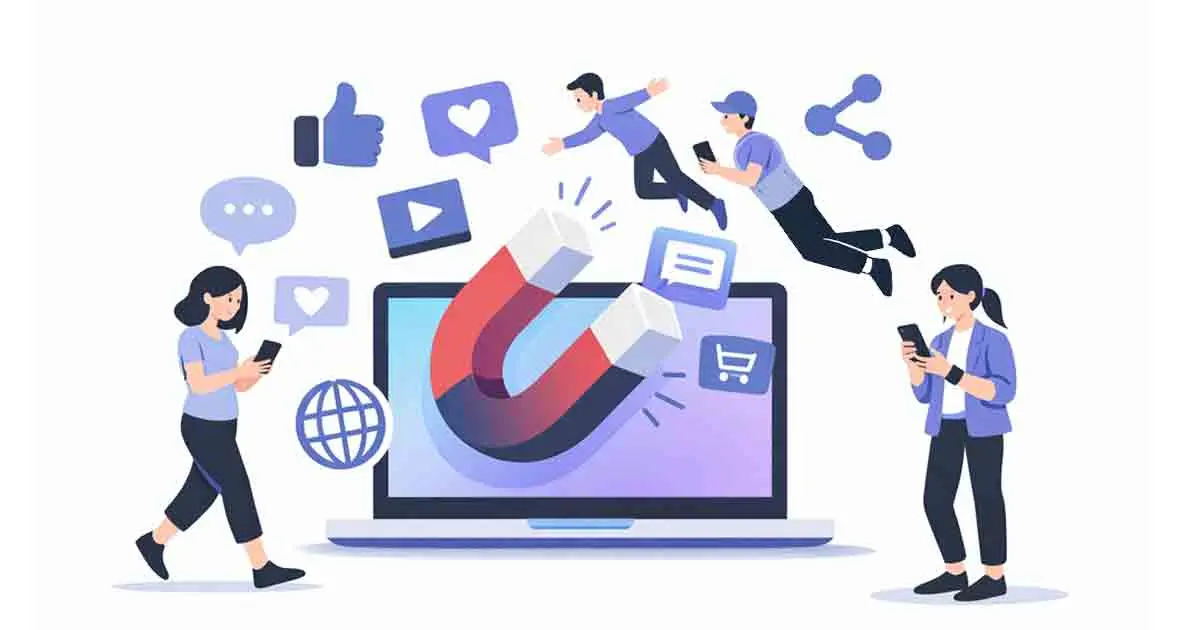
Social media is a significant component of inbound marketing as it helps reach qualified audiences, share valuable content at scale, build trust by engaging with them consistently, and direct prospects towards conversion in a natural manner. Inbound marketing relies on the ability to be findable, useful, and credible. Social platforms enhance all these functions by positioning educational content at the point of consumption by the audiences. Social media can be used to support all phases of the inbound methodology, including awareness, consideration, decision-making, and strengthen brand authority and long-term customer relationships when applied properly.
Key Takeaways
- Social media increases the inbound reach through distributing highly targeted content.
- It builds brand trust by means of conversation, openness, and social evidence.
- Platforms offer behavioral information that enhances personalization and conversion.
- Inbound growth is accelerated with the help of organic and paid social work.
- An organized plan makes social engagement to be congruent with quantifiable business results.
Interpretation of the Search Intent
Primary intent: Research intent
Users would like to understand clearly why social media should be a part of inbound marketing.
Supporting micro-intents:
- The way social media aids every phase of inbound marketing.
- The question of whether social media enhances lead generation or not.
- The impact it has on trust and brand authority.
- What evidence does it have in favor of its efficiency?
- Practical strategies to incorporate it in strategy.
This paper provides responses to all of these in a direct and systematic manner.
What Is Inbound Marketing?
Inbound marketing is a strategy that aims at capturing customers by providing them with pertinent and useful information instead of annoying advertisements. HubSpot formalized the framework and considered inbound to be a customer attraction, engagement, and delight process.
Inbound marketing is based on:
- Educational content
- Search visibility
- Trust-building communication
- Relationship-driven sales
All these pillars are reinforced by social media.
The reason Social Media is the key to Inbound Marketing
1. It Enhances Content Distribution
Inbound marketing is based on visibility. It is not enough to publish blog posts or guides without making them discovered.
Social platforms:
- Reach more content than search traffic.
- Facilitate demographic and interest-based promotion.
- Promote sharing which increases exposure.
The 2023 State of marketing reports by HubSpot indicate that more than three out of every five marketers claim that social media drives traffic to their websites. This affirms its position as an inbound content distribution engine.
Inbound strategies are dependent on search engine rankings without social media. Brands become aware faster with social media.
2. It Fits the Way Modern Audiences Consume Information
The consumer behavior has changed radically in the last ten years. According to the data provided by Pew Research Center, most adults visit at least one social platform regularly, and the younger age groups use social media as their main source of information.
This change of behavior has strategic consequences:
- Customers study brands on the social front before accessing websites.
- Peer reviews have an impact on decision-making.
- Perception is formed through visual and short-form content.
Inbound marketing needs to reach out to audiences in their locations. That is a social environment today.
3. It Forges Trust by involvement
The basis of inbound marketing is trust. The social media facilitates direct communication which enhances credibility.
Through:
- Comments and replies
- Educational live sessions
- Transparent communication
- Customer testimonials
Brands are knowledgeable and sensitive.
According to the Content Marketing Institute, the key factor in successful B2B marketers is focusing more on the trust of the audience rather than direct promotion. Content Marketing Institute in its research points out that long-term authority is achieved through consistent, value-driven communication.
Social interaction will turn the passive readers to active participants. Such a change increases brand loyalty.
The way Social Media Helps Every Phase of the Inbound Funnel
Awareness Stage
At this point, users are finding out issues.
Social media contributes by:
- Posting of educational posts.
- Posting explainer videos.
- Emphasizing industry intelligence.
Platforms enable the ability to target exactly and therefore brands can target audiences that are aligned with a particular interest.
Consideration Stage
Solutions are being compared by prospects.
Social media facilitates this phase by:
- Sharing case studies
- Hosting Q&A sessions
- Offering product demonstrations.
Interactive material enables the prospects to seek clarification on questions in real time.
Decision Stage
Buyers are ready to choose.
Social proof is critical:
- Reviews
- Testimonials
- User-generated content
In a study conducted by Harvard Business Review, it is observed that peer persuasion has a strong influence on the buying behavior, especially in the online context. Perceived risk is minimized through social validation.
Is Social Media an effective Lead Generator?
Yes, when in line with inbound concepts.
The process of generating leads is enhanced due to the fact that social sites enable:
- Gated content promotion
- Retargeting campaigns
- Consultation by direct messaging.
- Lookalike audience targeting.
As per the industry standards, the rate of lead acquisition is higher in companies that combine social promotion with inbound content than in companies that only use organic search.
Strategic alignment is however the key to success. Random posting does not have any measurable results.
The Data Advantage: Behavioral Insights
Inbound marketing relies on the knowledge of user behavior. The social platforms deliver quantifiable data like:
- Engagement rates
- Click-through rates
- Audience demographics
- Conversion tracking
These insights enable marketers to narrow content and targeting strategies.
Google and other search engines are becoming more and more rewarding of brands that express the knowledge and interest. Social cues do not necessarily dictate rankings, but visibility and traffic trends of the brand have an impact on total digital authority.
Effective inbound marketing is based on data-driven refinement.
The Psychological Dimension
Social media enhances the power of inbound marketing since it complies with the basic human behavior:
- Individuals have faith in peer recommendations.
- Familiarity is created through repeated exposure.
- Uncertainty is minimized through conversations.
Marketing theorist Philip Kotler has been arguing a long time that the contemporary marketing is not about interruption, but relationship-building. Social platforms scale that principle to a large scale.
Relationship-building without inbound marketing is not complete. It is facilitated by social media on a daily basis.
Inbound Strategy Organic vs Paid Social
Organic and paid social are both inbound success.
|
Element |
Organic Social |
Paid Social |
|
Purpose |
Community building |
Accelerated reach |
|
Cost |
Time and content resources |
Advertising budget |
|
Speed |
Gradual growth |
Immediate exposure |
|
Best For |
Authority and loyalty |
Targeting and lead generation. |
A middle ground is a combination of the two.
Organic builds credibility. Paid increases reach and speed.
Real-World Example
A medium-sized B2B software firm adopted a formal inbound approach with the help of social distribution:
- Posted weekly educational blogs.
- Similar passages in LinkedIn and industry communities.
- Marketed whitepapers through paid advertisements.
- Active participation in comment boards.
Within twelve months:
- Website traffic increased
- Lead quality improved
- Sales cycles shortened
It was not the volume of advertising but the visibility and interaction of the content that was the driving force.
Common Misconceptions
“Inbound marketing is social media free.”
It is able, but slower and less dynamic. Social hastens exposure and interaction.
“Only brand awareness is done through social media.”
It also motivates lead generation, authority building and retaining customers.
“It is sufficient to post regularly.”
Success inbound needs to be strategic to the needs of the audience and not just volume.
Expert Perspectives
1. According to the 2023 State of Marketing report by HubSpot, businesses that combine social media and content marketing have increased engagement and flow of leads.
2. A study by Pew Research Center affirms that social platforms are still core to the way people take information and judge brands.
3. Publications by Harvard Business Review underscore the fact that digital trust and peer validation play an important role in driving the purchasing decision.
These results support the structural significance of social media in the inbound marketing systems.
Actionable Remedies to Enhance Social-Based Inbound Marketing
- Match social content with key strategy.
- Recycle long-form content into platform-specific content.
- Targeting Use analytics to refine targeting.
- Promote interactive communication as opposed to one-way communication.
- Measure results not just vanity metrics.
Inbound marketing is a discipline that needs consistency.
You also read about previous content: Social Media Silent Scroller Traits
Conclusion
Social media plays a significant role in the inbound marketing since it helps increase the reach, establish trust, facilitate all buyer journey phases, and offer quantifiable behavioral data. It turns the content that is not moving into movement and makes the brands more powerful in the competitive markets.
The more organizations use social media in a strategic and not casual manner, the more visibility they have, better lead generation, and long lasting customer relationships.
The next logical move to make in terms of sustainable growth of a brand is to consider social media not as a channel, but as a structural element of inbound architecture. Brand in Marketing uses this disciplined method to assist organizations in turning attention to trust and trust to measurable outcomes.
Frequently Asked Questions
1. What is the importance of social media in the success of inbound marketing?
Since it increases the exposure of the content, creates trust by engaging, and generates qualified traffic into the inbound funnel.
2. Is it possible to do inbound marketing without social media?
Yes, but it grows at a slower rate and is more reliant on search positions.
3. Does social media enhance SEO?
Although social indicators are indirect ranking factors, greater publicity and traffic may reinforce general online authority.
4. What are the most appropriate platforms to use in inbound marketing?
The ideal platform will be based on the demographics of the audience, industry, and type of content. Brands that are B2B tend to favor LinkedIn, whereas consumer brands can use Instagram or TikTok.
5. What is the effect of social media on buying?
Peer validation, reviews, repetition through exposure and direct engagement which minimizes uncertainty.
6. Does inbound marketing require paid social?
Organic engagement is the basis of credibility, and paid social hastens results and increases the accuracy of targeting.