

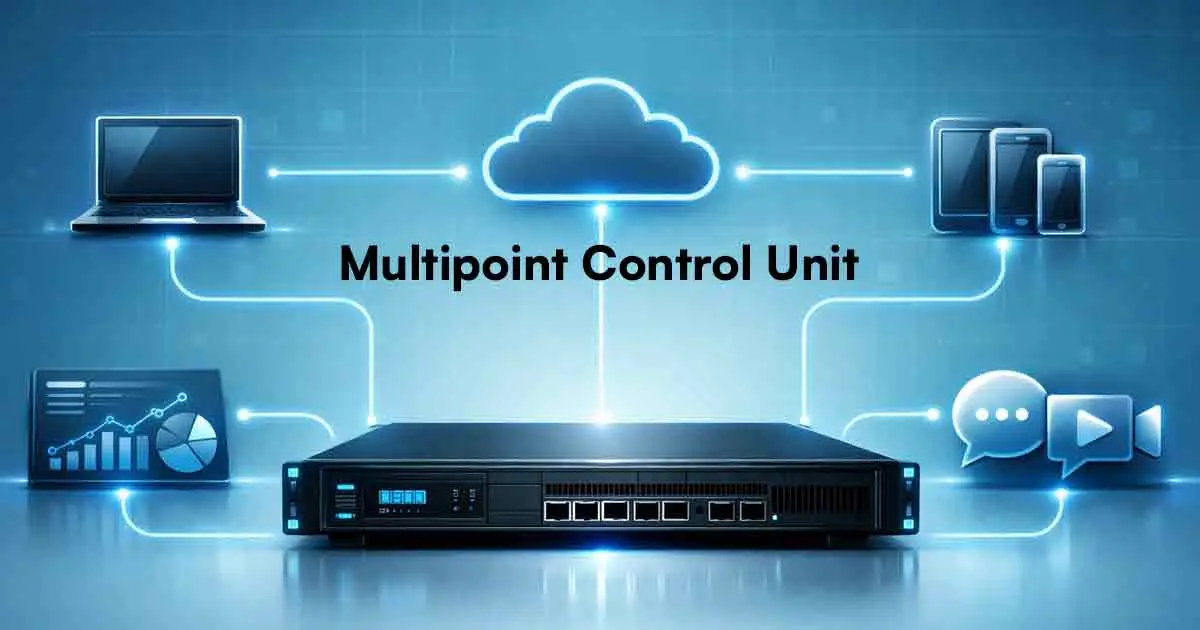
A Multipoint Control Unit (MCU) is a centralised system in video conferencing that links several participants into one call through reception, processing, mixing and redistribution of audio and video streams. The MCU is a central point that integrates all the inputs of all the participants into a single output to all the users instead of each participant communicating directly with other participants.
Key Takeaways
- Definition: MCU is a central server, which supports a multi-user video conferencing.
- Basic Operation: It combines and processes audio/video streams into one output.
- Type of architecture: Centralized (server-side processing)
- Primary Advantage: Makes communication easier to the user and compatible.
- Limit: High processing power and infrastructure are required.
- Modern Relevance: Continues to be used together with more modern systems such as SFU in certain applications.
What Is a Multipoint Control Unit?
A Multipoint Control Unit (MCU) is a hardware or software-based device that connects two or more video conferencing terminals into one session. It serves as the brain of a conference by taking care of streams, managing layouts and making sure that everyone can communicate effectively.
Simply put, it works as a live video production studio, in which several inputs are merged into a single output to all viewers.
Definition
A Multipoint Control Unit (MCU) is a centralized video conferencing system which receives, processes and integrates audio and video transmission of several participants into one single video stream to be distributed to all users.
The Multipoint Control Unit operation
Step-by-Step Process
1. Stream Collection
All the participants transmit audio and video streams to the MCU.
2. Decoding
All the incoming media streams are decoded by the MCU.
3. Processing and Mixing
It integrates streams into one layout or chooses active speakers.
4. Encoding
The mixed stream is re-coded to be delivered.
5. Distribution
A single stream is retransmitted to the participants.
This is done to guarantee synchronization, uniform layout and seamless communication between devices.
Core Functions of an MCU
1. Audio and Video Mixing
The MCU integrates several streams in a single composite output to make sure that all participants see the same picture.
2. Transcoding
It translates media formats in order to ensure that different devices and networks communicate with one another.
3. Layout Management
Regulates the display of the participants on the screen, either grid view or speaker view.
4. Conference Control
Manages participants, permissions and session control.
5. Bandwidth Optimization
Optimizes the quality of streams depending on the network conditions and capabilities of the devices.
Types of Multipoint Control Units
|
Type |
Description |
Use Case |
|
Hardware MCU |
Dedicated physical device | Enterprises, old systems. |
|
Software MCU |
Cloud or server-based solution |
Scalable deployments in the modern world. |
| Hybrid MCU | Combination of both |
Mixed infrastructure businesses. |
Flexibility and scalability have become popular with modern systems preferring software-based MCUs.
MCU vs SFU vs Peer-to-Peer
The comparison of MCU to other architectures can help to understand it better:
|
Feature |
MCU | SFU | Peer-to-Peer |
|
Processing |
Centralized | Partial | Distributed |
|
Stream Handling |
Mixed into one | Forwarded individually | Direct exchange |
| Bandwidth (Client) | Low | Medium |
High |
| Server Load | High |
Medium |
Low |
| Scalability | Moderate | High |
Low |
Quick Explanation
- MCU: Merges all streams into a single one.
- SFU: Forwards streams non-mixing.
- P2P: Person-to-person connections.
The benefits of Multipoint Control Units
1. Simplified User Experience
The stream is sent to one stream to the participants, lessening processing needs on the device.
2. High Compatibility
Supported by various devices, codecs, and types of networks.
3. Consistent Output Quality
The layout and synchronized content are visible to all users.
4. Centralized Control
Less difficult to handle conferences, security and recording.
MCU Architecture limitations
1. High Processing Demand
Stream decoding and re-Encoding are very CPU-intensive tasks on MCUs.
2. Scalability Challenges
Large numbers of participants may lead to performance degradation.
3. Cost
Older hardware MCUs are costly to install and maintain.
MCU in the Real World
Enterprise Video Conferencing
Applied in business settings in meetings, webinars, and remote working.
Telemedicine
Enables physicians and experts to reach patients in other places.
Online Education
Granted virtual classrooms in multiple participants.
Government and Defense
Guarantees safe and centralized communication channels.
Evolution of MCU Technology
MCUs were originally hardware systems that had to be dedicated infrastructures. They are currently commonly software-based and hosted on a cloud, which makes them more scalable and accessible.
More recent architectures such as Selective Forwarding Units (SFUs) have become available though, and are more scalable. Nevertheless, MCUs are still necessary in areas where quality management and compatibility are of paramount importance.
Expert Insights
“MCU is a central point that brings various participants together in one session.”
“It feeds on several inputs and generates a single professionally mixed output.”
“The MCU specifies the quality of video conferencing, its stability, and its performance.”
These observations underscore the presence of the MCU as the foundation of conventional video conferencing systems.
Practical Example
Take an example of a business meeting of 10 people:
- In the absence of MCU: Every participant will have to process several incoming streams.
- In MCU: Each participant transmits one stream and gets one combined stream.
This minimizes the load of the devices and provides a consistent experience to all users.
You also read about previous content: 127.0.0.1:62893 Explained Troubleshooting Common Daily Errors
Conclusion
Multi point control unit is a core technology of video conferencing that provides centralized control, uniform quality and ease of use. Although the newer architectures like SFU are more scaled, MCUs remain a crucial component in the setting where reliability, compatibility, and media processing control are required.
In the case of organizations that consider communication infrastructure, MCU and newer options should be chosen based on scale, performance needs, and system complexity. The knowledge of how MCU functions gives a solid foundation in making sound judgments in the contemporary communication systems.
FAQs
1. What is MCU in video conferencing?
MCU is Multipoint Control Unit which is a system that provides multi-user video conferencing.
2. How is MCU different from SFU?
MCU combines all streams into a single stream whereas SFU transmits streams without any processing.
3. Is MCU still used today?
Yes, particularly in the enterprise world where high levels of control, compatibility and quality are needed.
4. Why are MCUs expensive?
They demand a lot of processing power and infrastructure to process real-time media encoding and decoding.
5. Can MCU be software-based?
Yes, current MCUs are frequently cloud-based software platforms as opposed to hardware.