
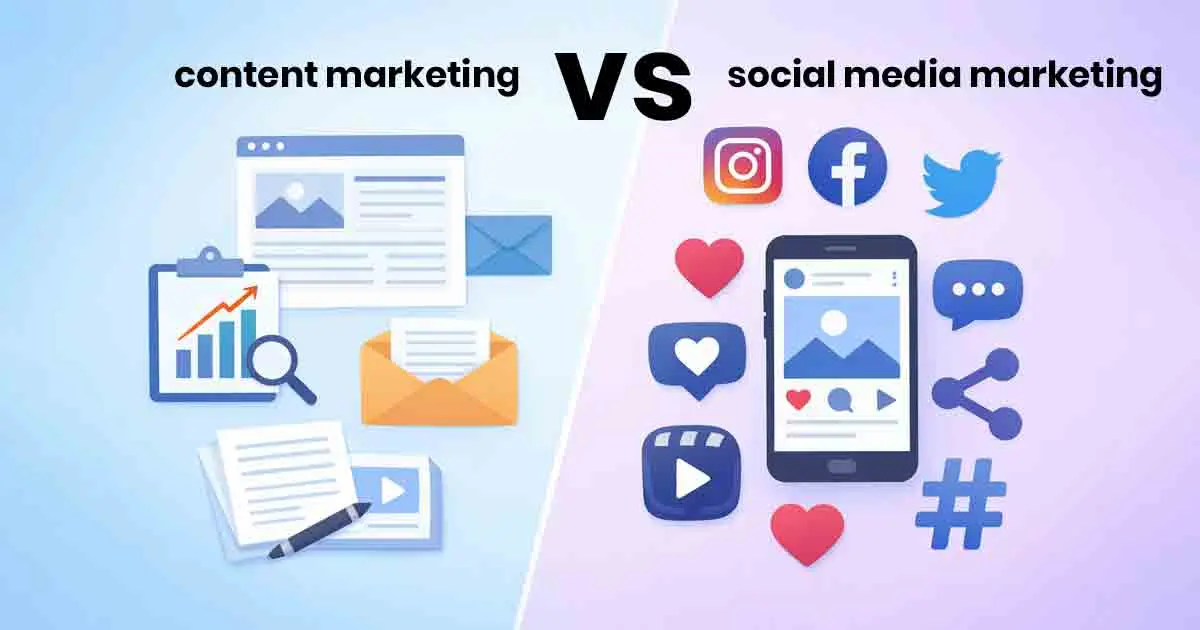
Content marketing and social media marketing is a strategic comparison of two different yet complementary strategies of digital development. The content marketing strategy is based on the development of valuable, long-form, search-optimized content, including articles, guides, and videos that appeal to audiences in the long-term. The focus of social media marketing is on the distribution of messages via Instagram, LinkedIn, and Tik Tok to develop engagement and brand awareness in the shortest possible time.
Practically speaking, content and social media marketing create long-term authority and organic traffic and immediate visibility and engagement, respectively. The combination of the two is advantageous to most modern businesses, but only the appropriate focus is based on objectives, budget, industry, and time frame.
Key Takeaways
- Long-term organic visibility is created by content marketing in the form of blogs, guides, white papers, and SEO assets.
- The social media marketing creates the short term interaction and brand awareness by interaction on the platform.
- Content marketing is a compounding process. The marketing of social media relies on the algorithms of platforms.
- Studies indicate that companies that focus on content marketing create a lot more leads compared to those that do not.
- The most effective approach is to combine both of them under the same brand message.
What Is Content Marketing?
Content marketing is the art and science of producing and disseminating valuable, relevant information that will draw and keep a well-defined audience.
The Content Marketing Institute defines content marketing as “a marketing strategy that aims at producing and sharing valuable, relevant and consistent content to attract and keep a well-defined audience.”
This is a strategy that values education, trust and long term visibility.
Essential Elements of Content Marketing
|
Component |
Purpose |
Example |
|
Blog articles |
Search visibility |
SEO-optimized guides |
|
White papers |
Authority building | Industry research report |
| Case studies | Proof and credibility |
Customer success story |
|
Email newsletters |
Retention | Educational email series |
| Video explainers | Engagement |
Product tutorials |
Why Content Marketing Works
The research intent and problem-solving intent are close to content marketing. The advertisements are usually met by the users before they find answers to their queries.
According to HubSpot research, businesses that post blogs regularly get much more traffic to their websites compared to businesses that do not. They always report inbound strategies based on content produce more leads with less long-term cost than outbound approaches.
Moreover, content resources keep on attracting traffic even after they are published. An article that is well-written can be in the search results over years.
What Is Social Media Marketing?
Social media marketing is the application of social networking sites to market products, services, or brand messages on organic posts and using paid advertisements.
As opposed to content marketing, which exists mainly on owned platforms, like websites, social media marketing is found in third-party ecosystems.
Essential Foundations of Social Media Marketing
|
Platform |
Primary Audience | Common Use |
|
|
Visual consumers | Brand awareness |
|
|
Professionals | B2B positioning |
|
|
Broad demographic | Community building |
| TikTok | Younger audience |
Short-form engagement |
| X | Real-time updates |
Conversation and trends |
According to the Statista data, billions of users actively use the social platforms globally, and social media is one of the biggest communication channels ever.
The reason why Social Media Marketing succeeds
Social media excels at:
- Immediate distribution
- Real-time engagement
- Community development
- Paid targeting precision
It endorses business and purchase intent by posting offers in feeds. But visibility is largely subject to platform algorithms and budgets on advertising.
Social Media Marketing vs Content Marketing: A Head-on Clash
Strategic Differences
|
Factor |
Content Marketing |
Social Media Marketing |
|
Ownership |
Owned media |
Rented platforms |
|
Longevity |
Long-term traffic |
Short lifespan posts |
|
Intent alignment |
Studies and critical thinking |
Engagement and awareness |
|
ROI timeline |
Slow build, high compounding |
Immediate but short-lived |
|
SEO impact |
High |
Minimal direct impact |
Which Drives More Leads?
One of the most popular statistics published by the Content Marketing Institute suggests that content marketing produces a lot more leads than outbound marketing that is conducted traditionally and is also cheaper in the long run.
By comparison, social media is very effective in top-of-funnel attention and remarketing.
According to marketing analyst Neil Patel, companies that use social media traffic alone are volatile because of changes in the algorithms. His analysis highlights the value of owned content assets to be stable.
When Content Marketing is the Way to Go
Content marketing is optimal when:
- You desire sustainable growth of traffic.
- Your audience does research prior to buying.
- You are trying to establish a market presence in a competitive market.
- You operate in B2B industries
- One of the major acquisition channels is SEO.
Finance, healthcare, SaaS and education are industries that gain a lot of advantages through detailed informational content.
According to a report by Gartner, B2B buyers take much time in conducting independent research before they can talk to the sales representatives. This renders learning material to be important.
When to adopt Social Media Marketing
The use of social media marketing is optimal when:
- Your product is visual or style based.
- The short-term objective is brand awareness.
- You initiate campaigns that are time sensitive.
- You are dependent on influencer relationships.
- You are aiming at younger age groups.
Social platforms frequently result in quick profits by fashion brands, consumer goods companies, restaurants, and entertainment services.
Can You Use Both Together?
Yes. As a matter of fact, integration brings about the best outcomes.
How Integration Works
- Post a detailed manual on your webpage.
- Extract important information on social posts.
- Refer traffic to the entire resource.
- Capture email subscribers.
- Content is the way that nurture works.
This cycle is a blend of the long-term power and the short-term involvement.
Comparison of Costs: Content vs Social Media
|
Cost Factor |
Content Marketing | Social Media Marketing |
|
Production |
Writing, design | Visual content, video |
|
Distribution |
SEO effort | Paid ads often required |
| Longevity | High ROI over time |
Continuous spending needed |
| Platform risk | Low |
High |
In the long-term, content marketing is likely to lead to a decrease in cost per lead due to the compounding nature of assets. Social media may need long-term advertising.
Expert Perspectives
Joe Pulizzi, the founder of Content Marketing Institute has pointed out that companies need to think like publishers and not advertisers. He asserts that long-term competitive advantage is achieved through building of audience.
According to Ann Handley, the Chief Content Officer at MarketingProfs, content marketing takes clarity, relevance, and empathy over volume.
In the meantime, digital strategist Rand Fishkin, the founder of SparkToro, has warned that excessive dependence on social algorithms puts brands at risk of losing visibility in a flash.
These professional opinions support one and the same idea: control and credibility are important.
You also read about previous content: Why Is Social Media an Important Part of Inbound Marketing?
Conclusion
Social media marketing and content marketing are used to achieve varying strategic goals. Content marketing establishes a long-term authority, search presence, and credibility. Social media marketing is fast, interactive, and focused.
The strongest brands that have used the combination of both strategies and have retained the ownership of the core content assets. Content marketing is the foundation of organizations that want to be stable, predictable in the traffic, and have long-term ROI. That foundation is increased by social media.
We at Brand in Marketing are urging business to base marketing structure on buyer behavior and not on trends. Research-based balanced approach delivers quantifiable and lasting growth.
Frequently Asked Questions
1. What is the key distinction between content marketing and social media marketing?
The subject of content marketing is based on longer-term educational content that is hosted on owned platforms. Social media marketing is aimed at relaying messages in third-party networks to engage.
2. Is social media marketing a substitute of content marketing?
No. Social media can enhance content but seldom overtakes the power and search engine optimization advantages of owned content assets.
3. What is the length of time that content marketing requires?
Depending on competition and consistency, most strategies start generating organic traffic that can be measured in three to six months.
4. Do B2B companies need social media marketing?
Yes, especially sites like LinkedIn. Nonetheless, B2B organizations tend to be more content intensive.
5. Which approach will be more profitable in the long run?
Typically, content marketing has a greater long-term ROI because it provides exponential organic visibility and less reliance on advertisement budgets.