
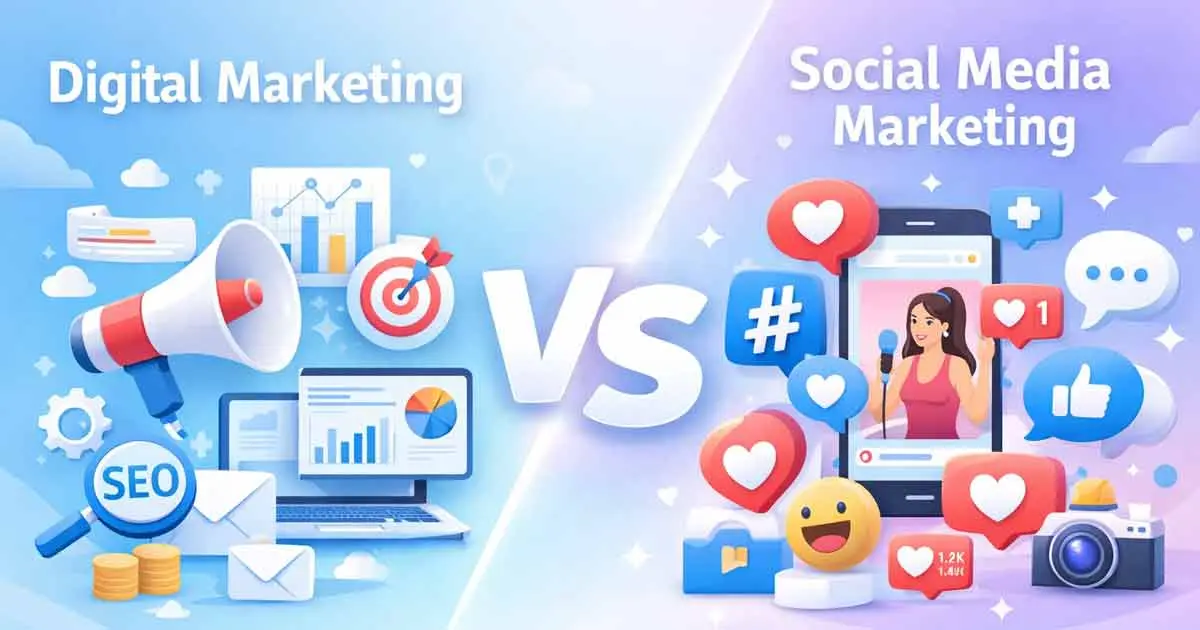
Digital marketing is the more general approach of marketing products or services via all digital platforms, whereas social media marketing is a smaller subcategory that only targets such platforms as Facebook, Instagram, LinkedIn, and Tik Tok. Concisely, one of the aspects of digital marketing includes social media marketing. Firms that know this difference will be able to spend budgets in a more effective way, select the right tools, and match campaigns to quantifiable goals.
This difference is not an academic one in case of companies dealing with Brand in Marketing. It dictates the way the resources are invested, the way performance is measured and the way brand equity is created in the long run.
Key Takeaways
- Digital marketing consists of SEO, paid search, email marketing, content marketing, display advertising, affiliate marketing and social media.
- Social media marketing concentrates only in social media to engage, advertise as well as create brand awareness.
- Digital marketing focuses on traffic, leads, and conversions on a channel basis.
- The emphasis of social media marketing is on engagement and community building as well as platform-based targeting.
- The two approaches are most effective when incorporated in a single marketing system.
Digital Marketing Understanding
Digital Marketing is a term used to define marketing that uses the Internet as its medium.
Digital marketing means any marketing that is done using digital media such as search engines, websites, email, mobile applications, and social media.
Research released by Statista shows that the world spent over $600 billion in digital advertising in 2023, which shows the prevalence of digital channels in the growth of the business.
Key Digital Marketing Building Blocks
Common components of digital marketing are:
|
Channel |
Purpose | Primary Goal |
|
Search Engine Optimization (SEO) |
Improve organic rankings |
Increase website traffic |
|
Pay-Per-Click Advertising (PPC) |
Paid search visibility |
Generate qualified leads |
|
Content Marketing |
Educational or informative material |
Build authority and trust |
|
Email Marketing |
Direct communication | Nurture prospects |
| Affiliate Marketing | Third-party promotion |
Expand reach |
|
Display Advertising |
Visual banner ads |
Brand awareness |
| Social Media Marketing | Platform engagement |
Community growth |
One of the elements in this structure is social media marketing.
What Is the Ultimate Goal of Digital Marketing?
The digital marketing is centered on the quantifiable business results:
- Lead generation
- Customer acquisition
- Revenue growth
- Optimization of conversion rate.
- Evidence-based performance monitoring.
The performance-driven aspect of digital strategy is supported by a 2023 industry report by HubSpot which found that 61 percent of marketers consider lead generation as their key challenge.
Being aware of Social Media Marketing
Definition of Social Media Marketing
The strategic application of social networking sites to market products, interact and create brand awareness among audiences is known as social media marketing.
Social media marketing exists within ecosystems, like Facebook, Instagram, LinkedIn, X, and Tik Tok, unlike larger digital campaigns.
Essential Goals of Social Media Marketing
Social media marketing focuses on:
- Brand visibility
- Audience engagement
- Community development
- Social listening
- Influencer collaboration
The statistics of Pew Research Center indicate that more than 70 percent of adults in the United States utilize at least one social media platform. Such a focus of attention renders social channels useful in awareness and brand engagement.
The Direct Comparison between Digital Marketing and Social Media Marketing
Scope and Reach
Digital marketing involves all digital contacts. Social media marketing is limited to social sites.
|
Factor |
Digital Marketing |
Social Media Marketing |
|
Scope |
Broad, multi-channel |
Platform-specific |
|
Strategy Level |
Top-tier ecosystem planning |
Channel execution |
|
Data Sources |
Analytics on websites, customer relationship management, advertisement statistics. |
Platform analytics |
|
Conversion Focus |
Strong emphasis | Secondary emphasis |
|
Community Building |
Limited |
Core strength |
Traffic vs Engagement
Digital marketing tends to focus on traffic and quantifiable conversions to the site.
The social media marketing is more concerned with engagement measures like:
- Likes
- Shares
- Comments
- Follower growth
In his scholarly writing, marketing scholar Philip Kotler has noted that the contemporary marketing is more and more combined with relationships and performance indicators. The relational aspect of this equation is in social media.
When Do You think a Business should focus on Digital Marketing?
Digital marketing should be the priority of businesses in case:
- Pipelines Sales pipelines demand quantifiable lead generation.
- Websites sales are revenue generating.
- The search visibility must be long-term.
- The customer experiences are multi-digital.
Indicatively, an online retailer gains advantage of the combination of SEO, paid search, and retargeting advertisements. The social media would not be adequate in terms of reach in intent-based searches.
According to Gartner research, the most successful marketing teams incorporate at least four digital channels in combined campaigns. This cross channel approach generates better returns than single channel endeavors.
When Does a Business need to focus on Social Media Marketing?
The social media marketing is especially effective when:
- Brand awareness is low
- Pictorial narration is important.
- Purchasing decision is affected by community trust.
- The target market is very active on social media.
The content creators, fashion brands, restaurants, and lifestyle companies tend to enjoy good platform presence prior to committing a lot of money in technical SEO.
In commentary on the industry, marketing strategist Neil Patel observes that social media can be the quickest method of testing message and response to the audience before expanding to larger-scale campaigning.
The relationship between Digital Marketing and Social Media Marketing
Integrated Strategy Model
Instead of thinking of digital marketing and social media marketing as the competing strategies, successful companies combine both of them.
The practical model resembles the following:
- SEO generates traffic through search.
- Paid ads retarget visitors
- Social media fosters interaction.
- Email marketing transforms interest to revenue.
At Brand in Marketing, the campaigns are designed in a way that the channels complement each other. Social content can be used to drive users to conversion-optimized landing pages, and search campaigns can be used to attract users who learned about the brand through social exposure.
Budget Allocation: Investment or not?
No formula exists, though typical patterns of allocation are:
|
Business Stage |
Digital Marketing Allocation | Social Media Allocation |
|
Startup |
50% |
50% |
|
Growth Phase |
65% |
35% |
| Established Brand | 70% |
30% |
Brands at the initial stage tend to spend more on social interactions in order to achieve recognition. Established organizations usually redirect budget to high-conversion digital platforms.
Measuring Success: Matters that Matter
Digital Marketing Metrics
- Cost per acquisition
- Return on ad spend
- Organic traffic growth
- Conversion rate
Social Media Metrics
- Engagement rate
- Follower growth
- Share of voice
- Reach and impressions
The difference is significant. Digital marketing uses revenue as a measure of performance. The social media marketing quantifies the interaction with the audience as well as brand affinity.
Common Misconceptions
Social Media Marketing: Is It Enough?
No. The social media is not likely to support long-term revenue growth without other supporting means like SEO or email marketing.
Is Digital Marketing Paid Advertisement Only?
No. Digital marketing involves organic and paid marketing. Organic elements are SEO and content marketing.
Are they Interchangeable Terms?
No. Social media marketing is part of the larger digital marketing.
Case Study Example
One of the mid-sized retail brands that collaborated with Brand in Marketing was initially dependent only on Instagram promotions. Interaction was good but the number of website conversions was not constant.
After implementing:
- SEO optimization
- Google Ads based on high intent keywords.
- Email automation sequences
- Retargeting campaigns
The Revenue grew by 42 percent in six months. The social media was not neglected, but it was integrated into a coordinated digital ecosystem instead of being a single approach.
Expert Perspectives
- Philip Kotler stresses that contemporary marketing demands developing relationships and measuring their performance, which is the reflection of the balance between social interaction and digital analytics.
- Neil Patel often recommends companies to mix-up traffic channels instead of relying on a single platform.
- According to research released by Gartner, integrated multi-channel campaigns have been found to be more effective in ROI and customer retention as compared to isolated campaigns.
These professional opinions justify the notion that integration is more efficient than isolation.
Which Strategy Is Better?
It is not how one is better or the other, but which is suited to your goal.
Social media marketing can be enough in case the aim is to get the brand noticed instantaneously.
In case the aim is to have a predictable growth in revenue, a comprehensive digital marketing will have to be provided.
Both are needed in most organizations.
You also read about previous content: How to Start a Social Media Marketing Agency, Step by Step
Conclusion
Social media marketing and digital marketing are not competing strategies. Digital marketing is the integrated platform that facilitates quantifiable business expansion in search engines, email, paid advertising, and content platforms. The marketing of social media works within that system to create a presence, interest, and trust with the community.
Integration is the best strategy to be used by a business that aims at sustainable growth. Brand in Marketing organizes campaigns in such a way that search performance is boosted by social channels, paid advertising by organic growth, and data by all decisions. Those companies that consider social media as a part of a larger digital architecture perform better than those that use a single channel.
The rational follow-up is to analyze your marketing mix now. Determine disengagement and disconversion. Then put in place a synchronized plan that matches channels to quantifiable goals.
Frequently Asked Questions
1. Is digital marketing inclusive of social media marketing?
Yes. One of the subsets of the digital marketing system is social media marketing.
2. What is more revenue generating between digital marketing and social media marketing?
Digital marketing tends to produce higher direct revenue since it has high-intent platforms like search advertising and email marketing.
3. Is it possible to use social media marketing as the sole tool of a small business?
Yes in the early stages and no in the late stages. Nonetheless, SEO, email and paid search integration is normally needed in long-term growth.
4. Is SEO a social media marketing?
No. SEO is a digital marketing plan, which is concerned with search engine presence, rather than social media.
5. What should I allocate my marketing budget?
The budget is based on the level of growth, competition, and objectives. Businesses that are growth oriented tend to invest 60 to 70 percent in wider digital platforms and the rest in social interaction.